Baby only settles when you walk around: the bouncing-at-2 a.m. club
Babies have a built-in calming response to being carried by someone walking, so crying stops when you stand and starts when you sit. Why it happens, how long it lasts and how to save your back.
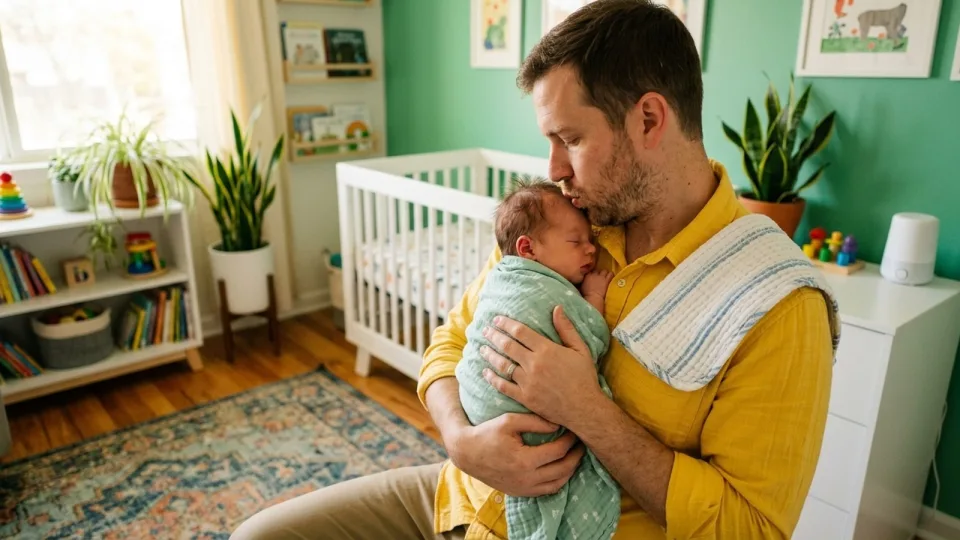
The second you stand up, the crying stops. The second you sit down, it starts again. So at 2 a.m. you're pacing the hallway, sometimes for hours.
You're not doing anything wrong. Babies have a calming reflex that kicks in when someone carries them while walking, and it's there in the first months, when crying peaks.
Why does walking work when sitting doesn't?
Scientists call it the transport response. In a 2013 study, babies under 6 months went quiet and stopped squirming almost immediately when their mom carried them while walking, and their heart rate slowed. Held by a seated mom, they didn't settle the same way.
In a 2022 study of 21 babies, moms walked their crying baby for 5 minutes. Every crying baby stopped, and nearly half dozed off. Sitting and holding didn't help, but a rocking crib did, so it's the steady movement that counts. Your baby isn't playing you. Young babies most likely can't settle themselves yet.
When does it get better?
Crying usually ramps up over the first weeks, tops out around 6 to 8 weeks and calms down by 3 to 4 months (sometimes later). If evenings are worst, here's more on evening crying in the early weeks.
How to put your baby down without waking them
In that 2022 study, over a third of the babies woke within 20 seconds of being laid down, and those asleep under about 8 minutes often woke. The researchers' tip is to walk for around 5 minutes at an even pace, then sit and hold your baby another 5 to 8 minutes before laying them down. Only 21 babies took part, so think of it as worth a try.
If your baby falls asleep in a carrier, swing, stroller or car seat, the AAP advises moving them onto their back on a firm, flat crib or bassinet mattress as soon as you can. If you might doze off, stay off the couch or armchair, where sleep-related deaths are many times more likely.
Easier ways to keep the motion going
A carrier or wrap keeps the rhythm of your steps going and leaves your hands free. The safety check is TICKS: Tight; In view at all times; Close enough to kiss; Keep the chin off the chest; Supported back. Take extra care with a sling if your baby is under 4 months or was premature.
Other options parents lean on:
- gentle bouncing on an exercise ball, feet flat, both arms around your baby
- stroller (pram) laps around the living room or the block
- a rocking chair or glider
- a white noise machine, set low, across the room
If another adult is around, trade shifts: one walks, the other sleeps.
What other parents say
The exercise ball comes up again and again as the back saver. Plenty of moms wait a few extra minutes before the transfer, lay the baby down feet first and keep a hand on the chest.
Feeling furious after an hour of fruitless pacing is common. It's fine to put your baby on their back in the crib and step out for 10 to 15 minutes. Never shake a baby. Here's more on handling those moments.
When to get help
Call your pediatrician right away if your baby:
- runs a fever of 100.4°F (38°C) or more and is younger than 3 months
- sounds different when crying: shrill, weak or just not their usual cry
- keeps crying for hours whatever you do
- isn't feeding well or has fewer wet diapers (nappies)
- throws up, particularly if the vomit is green
- seems floppy or is hard to wake
In the UK, call your GP or NHS 111. In an emergency, call your local emergency number (find it here).
The bottom line
Your baby is responding to movement the way babies are wired to. Whatever spares your back is fair game, as long as your sleeping baby ends up flat on their back. This phase usually fades by 3 to 4 months.
FAQ
Why does my baby start crying as soon as I sit down?
Being carried by someone who's walking calms babies under 6 months, and the calming effect is weaker when you sit. This is a normal reflex at this age.
Will walking my baby to sleep become a bad habit?
In the newborn months, walking or rocking them to sleep is fine. Older babies can come to count on that motion at every wake-up. To wean them off it, cut back slowly: a smaller bounce, then rocking, then patting in the crib. Some babies need less motion on their own once crying fades around 3 to 4 months.
Does it have to be mom doing the walking?
No. Only moms took part in the studies, but the lead researcher expects a similar effect with anyone who carries the baby. Hand the baby over and see.
Going through this right now? Talk to other parents in our Baby chat forum.
Sources
- Esposito G, et al. Infant calming responses during maternal carrying in humans and mice. Current Biology, 2013: https://pubmed.ncbi.nlm.nih.gov/23602481/
- Ohmura N, et al. A method to soothe and promote sleep in crying infants utilizing the transport response. Current Biology, 2022: https://pubmed.ncbi.nlm.nih.gov/36103877/
- RIKEN, Crying baby? Science says walk then sit (2022): https://www.riken.jp/en/news_pubs/research_news/pr/2022/20220914_1/index.html
- HealthyChildren.org (AAP), Colic: https://www.healthychildren.org/English/ages-stages/baby/crying-colic/Pages/Colic.aspx
- HealthyChildren.org (AAP), Calming a fussy baby: https://www.healthychildren.org/English/ages-stages/baby/crying-colic/Pages/Calming-A-Fussy-Baby.aspx
- HealthyChildren.org (AAP), A parent's guide to safe sleep: https://www.healthychildren.org/English/ages-stages/baby/sleep/Pages/a-parents-guide-to-safe-sleep.aspx
- HealthyChildren.org (AAP), Fever and your baby: https://www.healthychildren.org/English/health-issues/conditions/fever/Pages/Fever-and-Your-Baby.aspx
- U.S. Consumer Product Safety Commission, Safe babywearing: https://www.cpsc.gov/Newsroom/News-Releases/2011/CPSC-Educates-New-Parents-on-Safe-BabywearingInfant-suffocation-deaths-in-slings-prompt-renewed-effort-to-warn-moms-and-dads
- NHS Fife, The TICKS rule for safe babywearing: https://www.nhsfife.org/services/all-services/patient-advice/the-ticks-rule-for-safe-babywearing/
- Seattle Children's, Crying baby before 3 months old: https://www.seattlechildrens.org/conditions/a-z/crying-baby---before-3-months-old/
- NHS, Colic: https://www.nhs.uk/conditions/colic/
- NHS, High temperature (fever) in children: https://www.nhs.uk/conditions/fever-in-children/
- Royal Children's Hospital Melbourne, Sleep problems: babies and toddlers: https://www.rch.org.au/kidsinfo/fact_sheets/sleep_problems_babies_and_toddlers/
- KidsHealth NZ, PURPLE crying: https://www.kidshealth.org.nz/purple-crying
- Caring for Kids (Canadian Paediatric Society), Colic and crying: https://caringforkids.cps.ca/handouts/pregnancy-and-babies/colic_and_crying
- Hugh SC, et al. Infant sleep machines and hazardous sound pressure levels. Pediatrics, 2014: https://pubmed.ncbi.nlm.nih.gov/24590753/