Baby doesn't like cuddles: independent babies
A baby who squirms out of cuddles usually has a busy, curious temperament, and it isn't about you. Why it happens, how to be close anyway and when to mention it.
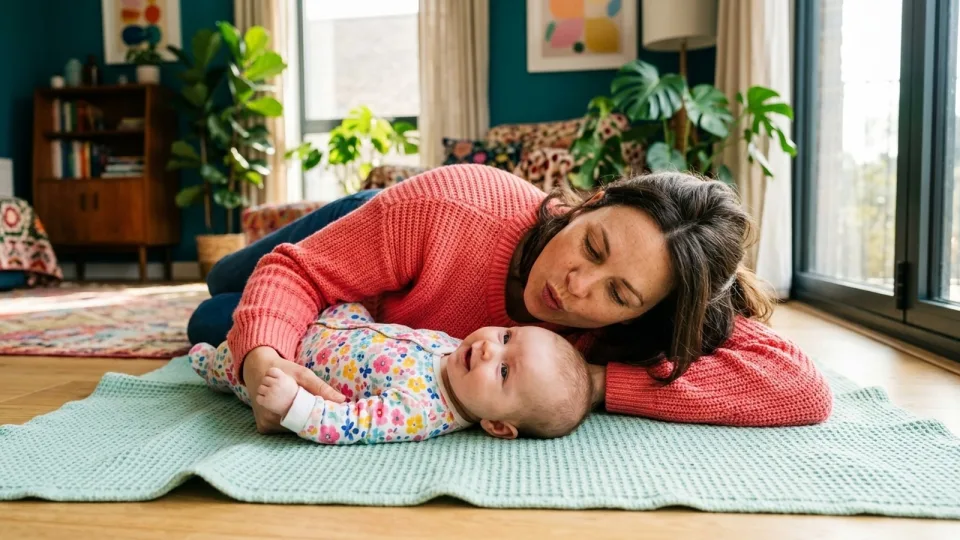
Your baby gets scooped up for a snuggle and answers with a wriggle, a stiff back and a twist of the head toward whatever is happening across the room. Back on the play mat, the smiles return.
This is usually temperament. Babies who dislike cuddles tend to be busy and curious, and it says nothing about their love for you. Plenty would rather look around and play than be held close. Many grow cuddlier with age, and in the meantime you can be close in ways a non-cuddler does enjoy.
Why won't my baby cuddle?
Temperament is something babies are born with, and two of its traits often explain a squirmy baby. Activity level is one: some babies are wigglier and more restless by nature.
Sensory threshold is the other. It's the amount of touch, noise or light a baby can take in before reacting, and a baby with a low threshold may find a hug, a rock and a chat all at once overwhelming.
Then there's curiosity. A more alert baby wants to see what's going on, and pressed against your chest, they can't. Facing out or sitting beside you gives them the view.
A twist away can also mean "not this cuddle, not now." Babies turn their heads and arch their backs to ask for a break or for something different. Being hot, overtired, gassy or uncomfortable makes babies push off too. If the arching and crying cluster around feeds, reflux may be involved.
Does this mean we haven't bonded?
It doesn't. Babies attach to the people who respond to them warmly and reliably, through feeds, comfort, play and answering their noises. Holding is one way of responding among many. The signs of a bond are relaxing with you, looking at you and lighting up when you come in, and non-cuddlers show them too.
Nothing you did made your baby this way. Temperament is largely inborn, so a C-section that delayed skin-to-skin isn't the cause, and neither is holding your baby "too much" or "too little."
Knowing that doesn't always take the sting out. Feeling rejected is common, more so if your baby beams at dad or at visitors. New faces are exciting, while you're the familiar base your baby explores from.
Low mood on most days, or still not feeling close to your baby after a couple of weeks or more, is worth telling your doctor about. Difficulty bonding can be a sign of postpartum depression, and that can start anytime in the first year.
Ways to be close to a baby who won't cuddle
Get face to face. Lie down on the floor next to them, or prop them on your lap so you're eye to eye. Talking, singing, pulling faces and copying their coos are all ways of being close.
Play on the floor. Stretch out in front of your baby for tummy time, or share a play mat or a board book. A lot of independent babies are happiest moving freely while you stay nearby.
Face them outward. Your lap facing the room works, and so does your hip. Plenty of carriers offer a facing-out option once a baby has strong head and neck control (often around 5 months). Your carrier's instructions say when. Whichever way you carry, keep your baby's face visible and their chin up off their chest, and lift them out to feed or when they doze off.
Try skin-to-skin. Newborns aren't the only ones who like it. A baby who fidgets in clothes may relax on your bare chest after bath time, and lots of parents carry on for months.
Give baby massage a go. Wait for a calm, alert spell at least 30 minutes after a feed. Use slow, firm strokes, since light ones can tickle. If your baby fusses or turns away, stop and try another day.
Let them lead. Offer a cuddle and release your baby as soon as they arch or twist. Lots of parents find that short snuggles their baby chooses go better than a long hold.
Notice the snuggly moments. Even non-cuddlers often snuggle in when they're sleepy, sick, fresh from the bath or winding down in the evening.
Do non-cuddly babies grow into cuddlers?
Many do. Temperament doesn't change much, though how it shows up shifts as children grow. Lots of parents find that a baby who fought every hug becomes a cuddly toddler, once they can crawl or walk away and come back on their own terms.
Other kids stay low on hugs for good and show affection differently: handing you things, staying near you, checking that you're watching.
What other parents say
Parents of non-cuddlers often describe a sunny, chatty baby who's happiest facing out, down on the floor or on the go. Cuddles, many say, came when the baby wanted them, mostly when tired, sick or warm from the bath. Feeling rejected comes up a lot, and so does relief when the wriggly baby turns into a clingy toddler.
Signs worth raising at a checkup
Not liking cuddles isn't a concern on its own. Mention it to your pediatrician (UK: GP or health visitor) if your baby also:
- rarely smiles back or looks at your face by 2 to 3 months (see 3-month-old not laughing yet)
- stops doing things they could do before
- feels very stiff or very floppy when you pick them up
- cries and arches at most feeds, or isn't gaining weight
The bottom line
Some babies care more about seeing the world than snuggling into you. Closeness on their terms still counts, and the wriggling isn't a verdict on how much they love you.
FAQ
Could not liking cuddles be a sign of autism?
By itself, no. Lots of babies who dislike being held are developing typically. Doctors look at social connection when they check for early signs: smiling back, eye contact, turning to their name, babbling and gestures such as pointing. If your baby does those things, the wriggling is most likely just temperament.
Why does my baby only want cuddles when tired?
A tired or sick baby needs comfort more than entertainment, and you're where they go for it. For a busy baby, the day often has no room for cuddles until bedtime.
Is it OK to keep offering cuddles?
Yes. What tends to work is offering without pushing: calm moments, short cuddles and letting go when your baby twists away. Holding on to a baby who's fighting you usually leaves you both frustrated.
Going through this right now? Talk to other parents in our Baby chat forum.
Sources
- HealthyChildren.org (American Academy of Pediatrics): How to Understand Your Child's Temperament. https://www.healthychildren.org/English/ages-stages/gradeschool/Pages/How-to-Understand-Your-Childs-Temperament.aspx
- HealthyChildren.org (American Academy of Pediatrics): Your Baby's Temperament. https://www.healthychildren.org/English/ages-stages/baby/Pages/Babys-Temperament.aspx
- HealthyChildren.org (American Academy of Pediatrics): The Benefits of Baby Massage. https://www.healthychildren.org/English/ages-stages/baby/Pages/The-Benefits-of-Baby-Massage.aspx
- MGH Clay Center for Young Healthy Minds: My 2-Year-Old Resists Being Held. https://www.mghclaycenter.org/parenting-concerns/infants-toddlers/2-year-old-resists-held/
- CDC: Milestones by 2 Months. https://www.cdc.gov/act-early/milestones/2-months.html
- CDC: Milestones by 9 Months. https://www.cdc.gov/act-early/milestones/9-months.html
- CDC: Milestones by 1 Year. https://www.cdc.gov/act-early/milestones/1-year.html
- NICHD (NIH): Cerebral Palsy fact sheet. https://www.nichd.nih.gov/health/topics/factsheets/cerebral-palsy
- MedlinePlus (NIH): Reflux in Infants. https://medlineplus.gov/refluxininfants.html
- Mayo Clinic: Postpartum depression. https://www.mayoclinic.org/diseases-conditions/postpartum-depression/symptoms-causes/syc-20376617
- Caring for Kids (Canadian Paediatric Society): Attachment. https://caringforkids.cps.ca/handouts/attachment
- Caring for Kids (Canadian Paediatric Society): Autism spectrum disorder: What you need to know. https://caringforkids.cps.ca/handouts/behavior-and-development/autism-spectrum-disorder-what-you-need-to-know
- NHS: Signs of autism in children. https://www.nhs.uk/conditions/autism/signs/children/
- NHS: Reflux in babies. https://www.nhs.uk/conditions/reflux-in-babies/
- NHS: Skin-to-skin contact with your newborn. https://www.nhs.uk/best-start-in-life/baby/baby-basics/caring-for-your-baby/skin-to-skin-contact-with-your-newborn/
- HSE (Ireland): Baby carriers and sling safety. https://www.hse.ie/babies-children/child-safety/choking-strangulation-suffocation/baby-carriers-sling-safety/
- BabyBjörn: FAQ, when to carry facing outward. https://www.babybjorn.co.uk/faq/
- Raising Children Network (Australia): Baby cues. https://raisingchildren.net.au/babies/connecting-communicating/communicating/baby-cues
- KidsHealth NZ: Autism signs and symptoms. https://www.kidshealth.org.nz/autism-takiwatanga-asd/autism-takiwatanga-signs-symptoms