3-month-old not laughing yet: is that normal?
Yes. Most babies don't laugh out loud at 3 months. A little chuckle tends to show up around 4 months and a full laugh by 6, so right now the smiles, cooing and eye contact matter more.
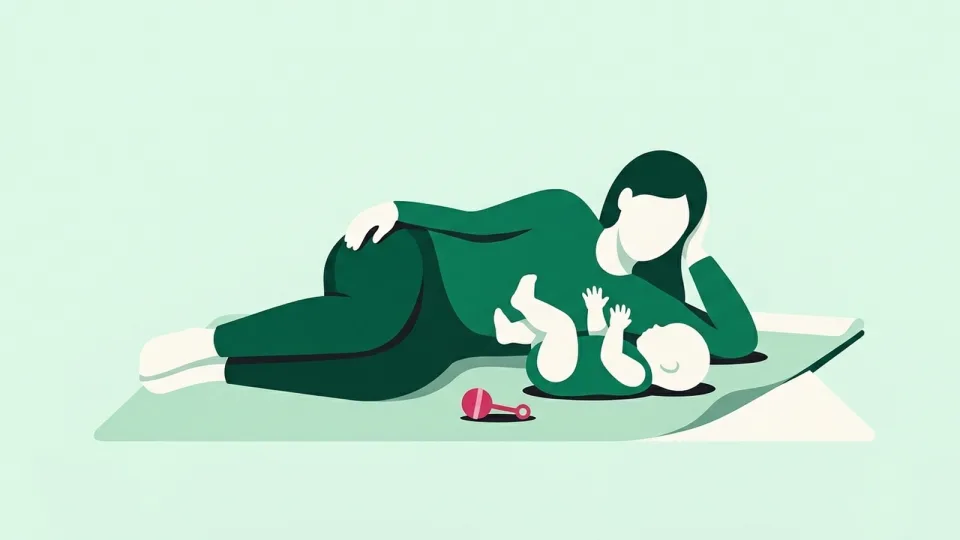
Your 3-month-old beams at you, but you're still waiting on that first real laugh.
Most babies this age haven't laughed out loud yet.
On the CDC's milestone checklists, "chuckles (not yet a full laugh)" shows up at 4 months, and a real laugh at 6 months. Each checklist lists skills that at least 75% of babies have by that age. For now, smiling, cooing and eye contact tell you far more than a giggle would.
When do babies start laughing?
Around 6 weeks, most babies give their first social smile, one that's aimed at you rather than a reflex.
By 4 months, most babies coo ("ooh," "aah") and let out little chuckles while you play. The full belly laugh usually arrives between 4 and 6 months, so a first laugh at 5 months is right on track.
What matters more at 3 months
Look for the social stuff instead. Does your baby smile back when you smile and chat? Do they watch your face, make little sounds, startle at loud noises and settle once you pick them up? By 4 months, most also smile unprompted to get your attention and turn toward your voice when you talk.
If your baby is doing those things, you don't need to worry about the missing laugh.
If your baby was born early
Go by corrected age, which is your baby's age since birth minus the number of weeks they arrived early. Say your baby came 6 weeks early and is now 3 months old. Their corrected age is about 7 weeks, right when a full-term baby is only beginning to smile. Stick with corrected age for milestones until about age 2.
How to encourage the first giggles
Choose a time when your baby is fed and wide awake, not the late-day stretch when lots of babies this age get cranky (more on that in fussy baby in the evenings at 3 months).
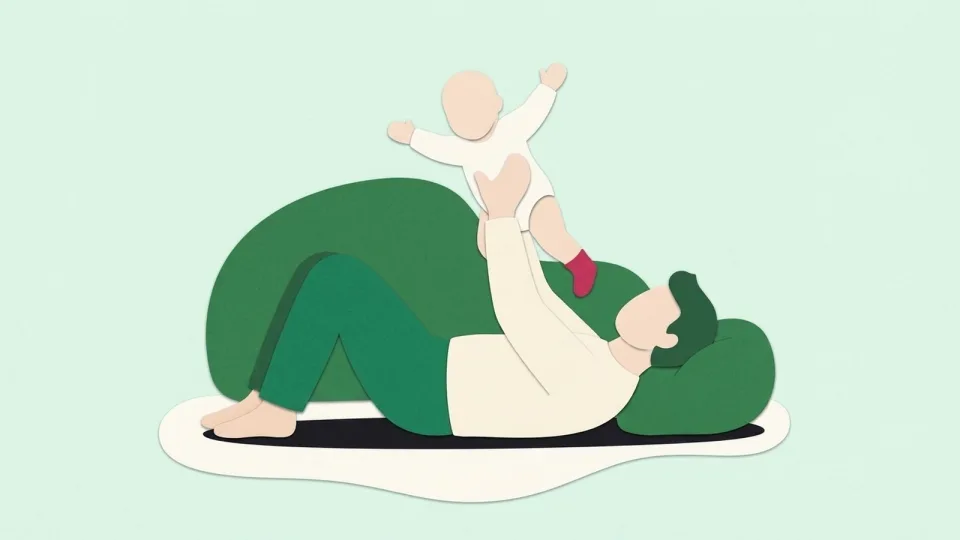
Get down to their level, face to face. Chat, sing, echo their sounds back to them, and look thrilled every time they coo at you.
Gentle physical play is often what sparks that first laugh:
- Blowing raspberries on their tummy
- Light tickles
- A silly, surprising noise
- Gentle bouncing on your lap
What other parents say
For plenty of parents, the first real laugh came later than they'd hoped, often closer to 5 or 6 months. Tickles or a big brother or sister clowning around tend to work better than funny faces. Some babies are smiley and chatty but just not big gigglers. For many, the worry only began after comparing their baby with others online.
When to get help
Check in with your pediatrician (or your health visitor or child health nurse) if your baby:
- Isn't smiling at you by about 3 months
- Doesn't react to loud sounds, or isn't turning toward your voice by 4 months
- Makes very little eye contact
- Isn't cooing or making any sounds, even now and then
- Has an eye that drifts in or out most of the time
- Doesn't follow moving objects with their eyes
- Loses a skill they used to have
- Isn't laughing or showing emotion by 6 months
Call, too, if your baby is hard to settle most days, or you're feeling down or on edge a lot of the time.
If something is bothering you, you don't have to wait for the next well visit.
US parents can also call their state's early intervention program directly. In the UK, talk to your health visitor or GP. In Australia, see your child and family health nurse or GP, or call healthdirect on 1800 022 222. In Canada, call your doctor, or 811 in most provinces.
The bottom line
Most 3-month-olds haven't laughed yet. Keep an eye out for smiles, coos and eye contact, and give that laugh until around 6 months to show up.
FAQ
Is it normal for a 4-month-old not to laugh?
Yes. Lots of 4-month-olds manage only a small chuckle, since a full laugh is a 6-month milestone. As long as there are smiles and coos, there's no rush.
My baby smiles but doesn't laugh. Is that OK?
Yes. At this age, smiling at you is the social skill that counts. Laughing tends to follow a few months later.
Can not laughing be a sign of autism?
Not by itself, and not at 3 months. The CDC's list of autism signs starts at around 9 months, with things like few facial expressions or not responding to their name. In the US, every child is meant to be screened for autism at the 18- and 24-month checkups. Still, if your baby hardly ever looks at you or smiles, mention it to your doctor.
Going through this right now? Talk to other parents in our Baby chat forum.
Sources
- CDC: Milestones by 2 months. https://www.cdc.gov/act-early/milestones/2-months.html
- CDC: Milestones by 4 months. https://www.cdc.gov/act-early/milestones/4-months.html
- CDC: Milestones by 6 months. https://www.cdc.gov/act-early/milestones/6-months.html
- CDC: Signs and symptoms of autism spectrum disorder. https://www.cdc.gov/autism/signs-symptoms/index.html
- Zubler JM et al. Evidence-informed milestones for developmental surveillance tools. Pediatrics 2022. https://stacks.cdc.gov/view/cdc/122643
- HealthyChildren.org (American Academy of Pediatrics): Developmental milestones, 3 months. https://www.healthychildren.org/English/ages-stages/baby/Pages/Developmental-Milestones-3-Months.aspx
- HealthyChildren.org (American Academy of Pediatrics): Corrected age for preemies. https://www.healthychildren.org/English/ages-stages/baby/preemie/Pages/Corrected-Age-For-Preemies.aspx
- HealthyChildren.org (American Academy of Pediatrics): How pediatricians screen for autism. https://www.healthychildren.org/English/health-issues/conditions/Autism/Pages/How-Doctors-Screen-for-Autism.aspx
- Lincolnshire Children's Therapy Services (NHS): Birth to 3 months. https://www.lincolnshirechildrenstherapyservices.nhs.uk/what-typical-development/0-2-years/0-3-months
- NHS: Newborn hearing screening, reaction to sounds checklist. https://www.gov.uk/government/publications/newborn-hearing-screening-reacting-to-sounds-checklist/newborn-hearing-screening-reaction-to-sounds-checklist
- Raising Children Network: Baby development at 3 to 4 months. https://raisingchildren.net.au/babies/development/development-tracker-3-12-months/3-4-months
- Raising Children Network: Developmental concerns in babies. https://raisingchildren.net.au/newborns/development/understanding-development/baby-development-issues
- Healthy WA: Child development 3 to 6 months. https://www.healthywa.wa.gov.au/Articles/A_E/Child-development-3-6-months