Baby cries with everyone except mom: is that normal?
Yes, it's normal. A baby who settles only with mom has a strong attachment to her, first through her voice, smell and feeds, later through stranger and separation anxiety. Here's how partners and grandparents can help, and when to get advice.
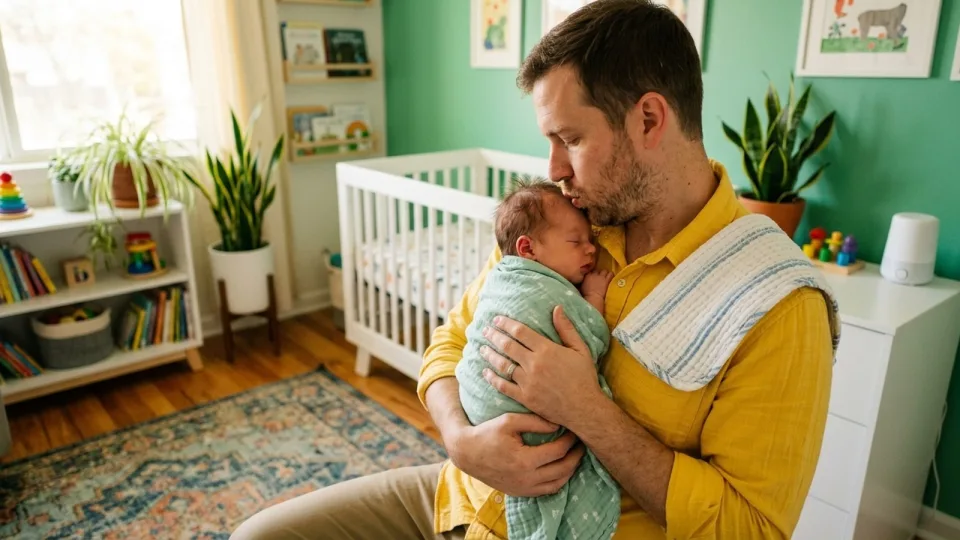
In your arms, your baby is content. Hand them to your partner, your mom or a sitter, and the wailing begins. It stops the second you take your baby back.
This is normal, and it's a sign of a strong, healthy bond with you. Nothing is wrong with your baby or with the person holding them. Most babies grow out of it, and until then, others can learn to calm them.
Why does my baby cry with everyone but me?
In the first few months, you're the person your baby knows best. Newborns already pick out their mother's voice from months of hearing it in the womb, and breastfed babies learn her smell within a couple of weeks. If you also do most of the feeds and holding, your baby connects you with milk and comfort.
From around 6 months, your baby knows familiar faces and notices when someone isn't you. That's stranger anxiety, and it can extend to people your baby sees all the time, like grandparents or a regular sitter. Dad can get the tears too, because by 7 or 8 months babies save a special response for whoever does most of their care.
Separation anxiety comes next. Your baby figures out that you can walk away, but not yet that you'll come back.
None of this means your baby doesn't love the other person, or that you've held your baby too much. Babies can form secure attachments to several adults through ordinary daily care.
How long does the mom-only phase last?
The newborn preference usually softens as other people do more of the hands-on care. Stranger anxiety tends to begin around 6 months, and by 9 months most babies are shy or clingy with strangers and cry or reach for you when you leave.
Separation anxiety typically peaks between 10 and 18 months. Both usually fade between 18 months and 2 years, though some kids stay wary of new people until age 3.
How do I get my baby to settle with someone else?
Choose the right time. Hand your baby over when they're fed, rested and in a good mood. If they're hungry or overtired, they'll want whoever has the milk.
Leave the room, or the house. Lots of babies settle with dad or grandma once you're out of sight and earshot. Take a shower or head out for a walk, and don't rush back at the first whimper. Start short and build up.
Stay on the move. Walking, swaying or a baby carrier often works better than sitting on the couch. A shirt that smells like you can help too.
Give the other parent a job of their own. Think bath time, the early shift while you sleep in, or the last walk before bed. When it happens daily, your baby learns that this person also means comfort. With a newborn, start with skin-to-skin on dad's chest.
Go slowly with grandparents and sitters. Have them play while your baby sits on your lap, then leave your baby with them briefly before trying a longer stretch. Keep goodbyes short and upbeat rather than slipping out, and always say hello when you're back.
If you're the one getting the tears, try not to take it personally, and keep showing up. Every bath and bedtime adds to the bond. If this phase is causing tension between you, read our guide to arguing with your partner after a baby.
What if I'm the only one who can calm the baby?
Being the one person who can soothe your baby wears you out. You still need breaks. If your baby is with a safe, loving adult, some crying while you're gone is OK.
If the crying ever brings you to the end of your rope, lay your baby down somewhere safe and walk away for a few minutes. Here's a plan for feeling angry when your baby won't stop crying.
What other parents say
Plenty of parents find this phase shows up twice: in the newborn weeks, then again somewhere between 6 and 12 months. Dad sticking to the same daily routine helped most. An overtired baby passed from lap to lap tended to cry with everyone. Many families also saw a strong "daddy phase" later on.
When to get help
Preferring mom isn't a medical issue on its own. Call your pediatrician (UK: GP, health visitor or NHS 111; Australia: GP, child health nurse or healthdirect 1800 022 222; Canada: your doctor or 811 in most provinces) when:
- the crying looks like pain or illness (crying when your baby is moved or held, a fever, seeming very unwell), or nothing settles your baby for more than 2 hours straight, not even you: call right away
- feeding is going badly or your baby isn't gaining weight
- your baby loses skills they had, or misses milestones
- the distress is intense, goes on long after you've left, or lasts more than a few weeks
See your own doctor too if you or your partner have felt down, hopeless or unable to enjoy anything for more than 2 weeks. Postpartum depression can start any time in the first year, and dads and partners can get it too.
In the US, call or text the National Maternal Mental Health Hotline at 1-833-852-6262. In Australia, call PANDA on 1300 726 306. If you're having thoughts of harming yourself or your baby, call 911 (US and Canada), 999 (UK), 000 (Australia), 111 (New Zealand) or 112 (Ireland) right away.
The bottom line
Your baby's clinginess shows they know exactly where home is. Keep making calm, regular time for your baby with the other people in their life, and keep taking your breaks.
FAQ
Is it normal for a baby to scream when dad holds them?
Yes, and it doesn't mean your baby dislikes dad. Mom is usually the person a baby knows best, especially if she handles most of the feeds. Over time, regular one-on-one care from dad, with mom out of the room, makes a difference.
How old are babies when they only want mom?
It tends to peak twice. First in the newborn months, then from about 6 to 18 months, when stranger and separation anxiety are at their strongest. For most kids, it eases off between 18 months and 2 years.
Should I hold my baby less so they get used to other people?
No. Responding warmly to your baby, every time, is how a secure attachment grows. Comfort your baby whenever they need it, and set aside regular time for other caregivers too.
Going through this right now? Talk to other parents in our Baby chat forum.
Sources
- HealthyChildren.org (American Academy of Pediatrics): Emotional and Social Development: 8 to 12 Months. https://www.healthychildren.org/English/ages-stages/baby/Pages/Emotional-and-Social-Development-8-12-Months.aspx
- HealthyChildren.org (American Academy of Pediatrics): Tips for Grandparents of 8 to 12 Month Olds. https://www.healthychildren.org/English/ages-stages/baby/Pages/Tips-for-Grandparents-of-8-to-12-Month-Old.aspx
- HealthyChildren.org (American Academy of Pediatrics): Dads Can Get Postpartum Depression, Too. https://www.healthychildren.org/English/ages-stages/prenatal/delivery-beyond/Pages/dads-can-get-postpartum-depression-too.aspx
- CDC: Milestones by 6 Months. https://www.cdc.gov/act-early/milestones/6-months.html
- CDC: Milestones by 9 Months. https://www.cdc.gov/act-early/milestones/9-months.html
- Merck Manual Consumer Version: Separation Anxiety and Stranger Anxiety. https://www.merckmanuals.com/home/children-s-health-issues/symptoms-in-infants-and-children/separation-anxiety-and-stranger-anxiety
- Seattle Children's: Crying Baby, Before 3 Months Old. https://www.seattlechildrens.org/conditions/a-z/crying-baby---before-3-months-old/
- Seattle Children's: Crying Child, 3 Months and Older. https://www.seattlechildrens.org/conditions/a-z/crying-child---3-months-and-older/
- HRSA: National Maternal Mental Health Hotline. https://mchb.hrsa.gov/national-maternal-mental-health-hotline
- NHS: Separation anxiety. https://www.nhs.uk/baby/babys-development/behaviour/separation-anxiety/
- NHS: Postnatal depression. https://www.nhs.uk/mental-health/conditions/post-natal-depression/overview/
- Caring for Kids (Canadian Paediatric Society): Attachment. https://caringforkids.cps.ca/handouts/attachment
- Raising Children Network: Fear of strangers (babies). https://raisingchildren.net.au/babies/behaviour/common-concerns/fear-of-strangers
- Raising Children Network: Separation anxiety (babies). https://raisingchildren.net.au/babies/behaviour/common-concerns/separation-anxiety
- PANDA: How dads can build a strong bond with their baby. https://www.panda.org.au/articles/how-dads-can-build-a-strong-bond-with-their-baby
- HSE: Separation anxiety. https://www.hse.ie/babies-children/checks-milestones/social-emotional-behavioural/separation-anxiety/
- DeCasper AJ, Fifer WP. Of human bonding: newborns prefer their mothers' voices. Science, 1980. https://pubmed.ncbi.nlm.nih.gov/7375928/
- Cernoch JM, Porter RH. Recognition of maternal axillary odors by infants. Child Development, 1985. https://pubmed.ncbi.nlm.nih.gov/4075877/