Baby wide awake and happy at 3 a.m.: what to do
A baby who is wide awake and happy in the middle of the night is usually just not sleepy. Here's why it happens, what to do at 3 a.m., and how daylight, naps and bedtime can end the night party.
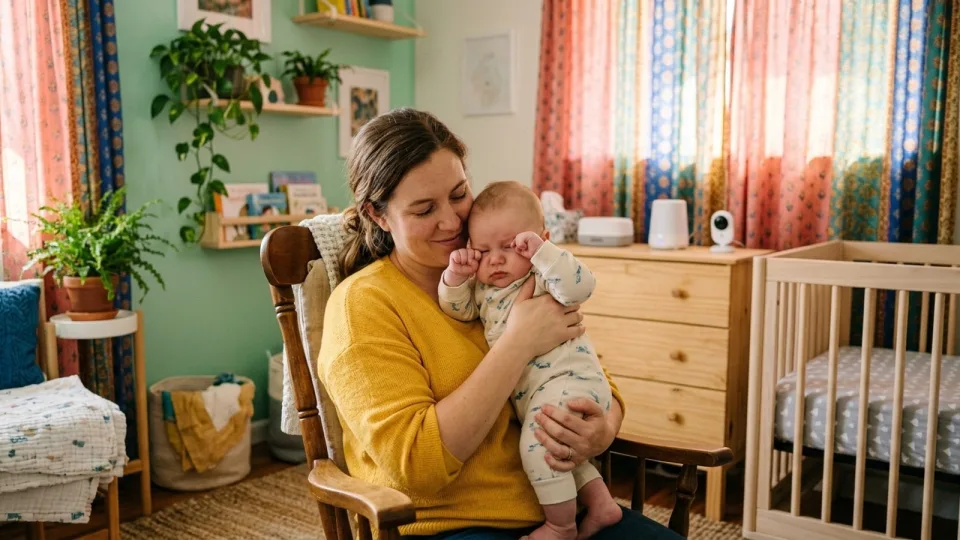
It's 3 a.m. and your baby is up, but nobody is crying. Instead there's cooing, babbling, kicking and a hand grabbing at toes. An hour later, they're still wide awake. Parents call this a split night.
It happens a lot, and it's usually harmless. A newborn hasn't worked out day and night yet. In an older baby, it tends to mean the daytime schedule and the body clock don't line up, or a new skill has their brain buzzing.
For tonight, keep the room dark and quiet and give your baby nothing interesting to do. Over the next week or two, work on daylight, naps and bedtime.
Why is my baby up and happy at 3 a.m.?
Everyone wakes briefly a few times a night and usually drifts straight back off. A long, cheerful waking means your baby isn't sleepy anymore.
Newborns can't tell day from night. They sleep 16 to 18 hours a day, in short bursts at any hour. A day and night rhythm starts to show from around 3 months.
After that, it's often because your baby has already had enough sleep. Babies between 4 and 12 months need roughly 12 to 16 hours in 24, counting naps. Long naps plus an early bedtime can mean your baby has slept enough well before morning.
Milestones play a part too. From around 6 months, separation anxiety and crawling can disrupt sleep, and a baby with a new skill may want to practice it at 3 a.m.
Do you go in or let them be?
If your baby is content and not crying, it's fine to let them babble. Plenty of babies drift back to sleep by themselves, as long as nobody turns the waking into playtime. Wait a few minutes before going in, even if a little fussing starts.
When you do go in, make it brief and boring. Keep the main light off; a dim night light is enough to see by. Say little, and say it softly.
Feed your baby if they seem hungry. Only change the diaper (nappy) if it's dirty or very wet. Then put them back in the crib (cot) on their back, still awake.
Leave out bright lights, screens and games. Don't put toys in the crib to keep them occupied either: even while your baby is awake, the crib should hold nothing but a firm mattress with a fitted sheet. For at least the first 6 months, the crib belongs in your room.
One more safety point: if there's any chance you'll doze off, don't bring your baby to the couch. The AAP warns that when a baby sleeps with someone on a couch or armchair, the risk of sleep-related death is up to 67 times higher.
Ending the 3 a.m. party
Make one change at a time and give it roughly a week.
Chase afternoon daylight. Take your baby out after lunch. In a study of babies aged 6 to 12 weeks, the good night sleepers got more light between noon and 4 p.m. At night, keep the room dark and exactly as it was when you put your baby down.
Add up your baby's sleep. For three days, jot down every nap and every stretch of night sleep. If the total sits near the top of the range and naps run for hours, trim the longest nap a little, or wake your baby from the last nap a bit sooner. Go easy, though, because an overtired baby wakes up more.
Check bedtime. A baby who goes down very early and naps a lot may do better with a bedtime pushed a little later every few days. If naps are poor and your baby is overtired, try an earlier bedtime instead.
Hold the morning wake-up steady. Same time every day, rough night or not.
Let your baby learn to fall asleep in the crib. Starting at about 4 months, put them down drowsy but still awake. Babies who drop off on their own at bedtime have an easier time getting back to sleep when they wake at night. If your baby only falls asleep while feeding, see my 5-month-old won't sleep unless fed.
With a newborn, keep things simple. Days are bright, with the usual household noise; night feeds happen in the dark, quietly.
Getting through it yourself
A baby partying at 3 a.m. can wear you down more than a crying one, because there's nothing to fix. If you can, split the night: one of you takes the first half, the other the second.
If you're doing this solo, ask a friend or relative to stay over for a few nights so you can catch up on sleep. Broken nights are hard on any relationship. If the two of you keep snapping at each other, arguing with your partner after a baby may help.
What other parents say
Parents often notice that a happy night waking wraps up sooner when they stay out of the room, while chatting or playing drags it out. For a lot of families, things improve within about a week of shortening the morning nap, switching an older baby to one nap, or waking the baby a little earlier. Others see no change, and the phase fades by itself after a few weeks or months.
When to get help
Check in with your pediatrician if:
- you hear loud snoring or gasping, or your baby seems to stop breathing briefly before a gasp
- your baby seems ill, in pain or unusually upset at night
- weeks of changes haven't touched the wakings, and your own sleep is wrecked
- you're worn out, feeling low or struggling to cope
UK parents can go to their health visitor or GP, or call NHS 111. In Australia, try your GP or a child health nurse, or call healthdirect on 1800 022 222. In most Canadian provinces, dial 811. In Ireland, get in touch with your public health nurse or GP. In New Zealand, you can call PlunketLine for free on 0800 933 922.
The bottom line
A baby who's wide awake and cheerful at 3 a.m. is usually healthy and simply not tired. Make nights dull and keep your baby safe in their own bare crib. Then fix the daytime one small step at a time.
FAQ
How long does a split night phase last?
Lots of parents notice a difference within about a week of adjusting naps and bedtime. For others, the phase passes by itself after a few weeks or months. When it drags on and you're exhausted, bring it up with your pediatrician or child health nurse.
Should I feed a baby who wakes up happy?
Yes, if they seem hungry. Most babies under 6 months still need night feeds. Keep them dark and quiet. If your baby takes only a little and stays wide awake, the waking probably has more to do with not being sleepy than with hunger.
Can I leave my baby awake in the crib?
Yes, as long as your baby is content, lying on their back in a bare crib, and sleeping in your room. If crying starts, take a quick look and see to hunger, a dirty diaper or any sign of illness.
Going through this right now? Talk to other parents in our Baby chat forum.
Sources
- American Academy of Pediatrics, HealthyChildren.org: Getting your baby to sleep. https://www.healthychildren.org/English/ages-stages/baby/sleep/Pages/getting-your-baby-to-sleep.aspx
- American Academy of Pediatrics, HealthyChildren.org: A parent's guide to safe sleep. https://www.healthychildren.org/English/ages-stages/baby/sleep/Pages/a-parents-guide-to-safe-sleep.aspx
- Paruthi S, et al. Recommended amount of sleep for pediatric populations (AASM consensus, endorsed by the AAP). J Clin Sleep Med, 2016. https://pmc.ncbi.nlm.nih.gov/articles/PMC4877308/
- Canadian Paediatric Society, Caring for Kids: Healthy sleep for your baby and child. https://caringforkids.cps.ca/handouts/healthy-living/healthy_sleep_for_your_baby_and_child
- NHS: Helping your baby to sleep. https://www.nhs.uk/baby/caring-for-a-newborn/helping-your-baby-to-sleep/
- East London NHS Foundation Trust: Nightwakings (Mindell and Owens). https://www.elft.nhs.uk/sites/default/files/2023-12/nightwakings.pdf
- HSE Ireland: Helping your child back to sleep, 0 to 6 months. https://www.hse.ie/babies-children/sleep/child-back-to-sleep-0-6-months/
- HSE Ireland: Helping your child back to sleep, 6 months plus. https://www.hse.ie/babies-children/sleep/child-back-to-sleep-0-6-months/child-back-to-sleep-6-months-plus/
- Raising Children Network (Australia): Baby sleep, 2 to 12 months. https://raisingchildren.net.au/babies/sleep/understanding-sleep/baby-sleep-2-12-months
- Tresillian (Australia): Baby sleep. https://www.tresillian.org.au/baby/sleep/
- Pregnancy, Birth and Baby (healthdirect Australia): Getting your baby to sleep. https://www.pregnancybirthbaby.org.au/getting-your-baby-to-sleep-infographic
- KidsHealth NZ: Normal sleep in babies 3 to 12 months. https://www.kidshealth.org.nz/normal-sleep-babies-3-12-months
- Harrison Y. The relationship between daytime exposure to light and night-time sleep in 6 to 12-week-old infants. J Sleep Res, 2004. https://pubmed.ncbi.nlm.nih.gov/15560769/